
Rostrum
The evaluation panel, before the evaluation panel.
Rostrum takes the stance of the board your team is about to present to. It reads the solicitation, joins the rehearsal on the platform your team already uses, questions each presenter in a spoken panel voice, and scores every answer against the criteria the real evaluators apply.
Know you are ready before the board does.
Rostrum makes orals preparation a measured exercise, and your pursuit material never leaves the boundary you approve.
Teams walk into orals having already faced the panel.
Presenters rehearse against a panel built from the actual solicitation and get a debrief in the ratings language evaluators use. Leadership sees whether each rep moved readiness instead of relying on how the room felt.
Losing points in the room, or losing control of the data.
Mock panels staffed by colleagues vary with whoever shows up, and over-claims or dodged questions often surface for the first time in front of the real board. Rostrum catches them in rehearsal, on self-hosted models your security team can approve.
Orals decide more awards, and capable AI now runs in the boundary.
Open-weight models are now good enough to run on infrastructure you control, while mainstream AI services stay off-limits for controlled bid material. Agencies are also starting to use AI in their own evaluations, which raises the bar for preparation.
From solicitation to scored rep.
The proposal lead controls what the panel knows and signs off on how it scores. Then the team rehearses, and every rep is measured.
Load and screen
Upload the solicitation, decks with speaker notes, scripts, and competitive intelligence, including scanned pages. Each file is checked for malware, classification markings, and personal data before it is indexed.
Derive the evaluation
Section M becomes an editable rubric and Section L a checklist of presentation rules. The proposal lead reviews and signs off on both, with full version history.
Build the panel
The panel persona draws on the agency material you load. Each claim the team plans to make is rated strong, thin, or unsupported in a claim ledger.
Rehearse live
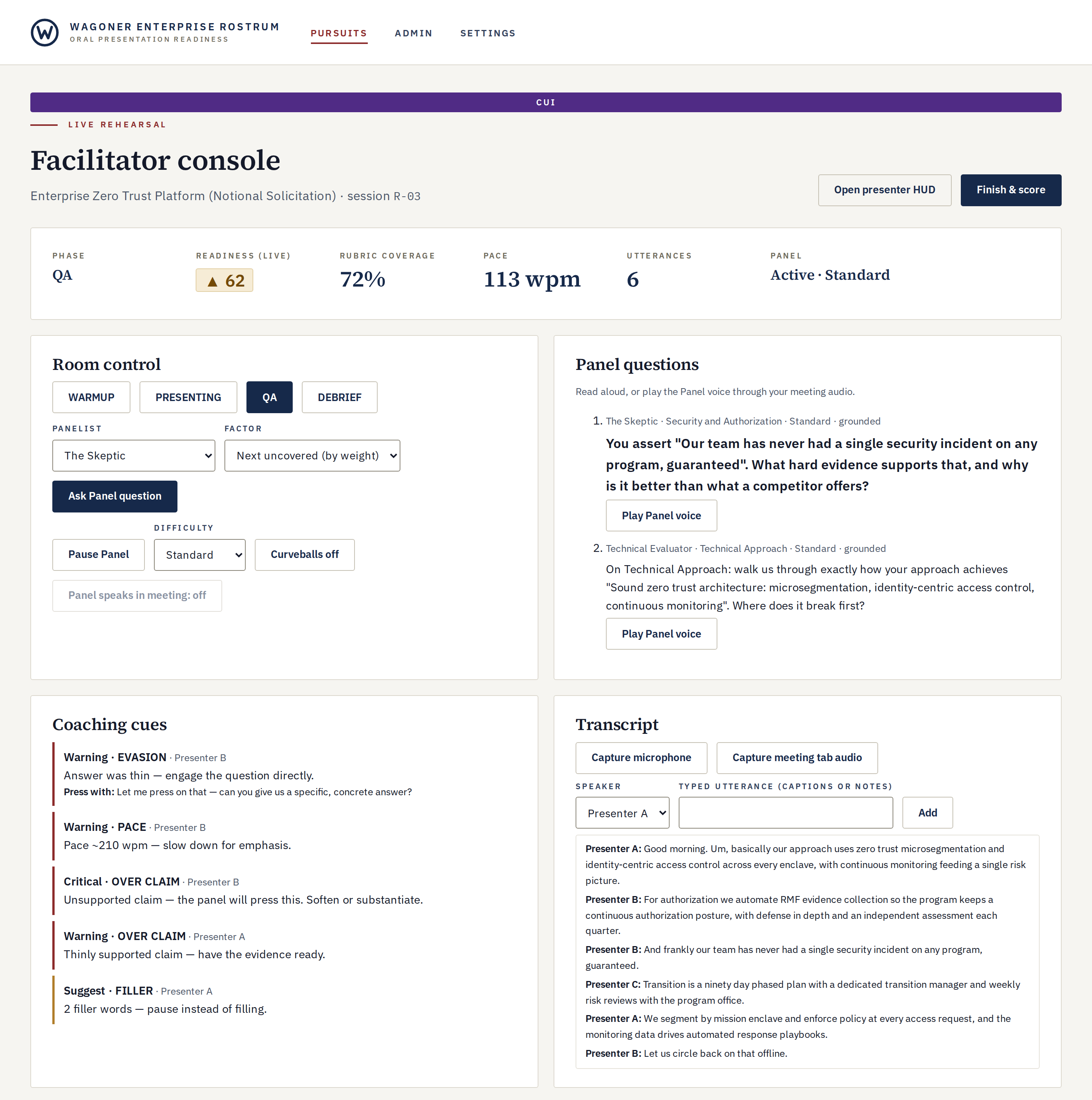
The team rehearses on its usual platform while self-hosted speech models transcribe and attribute each turn. Coaching flags delivery, substance, coverage, and evasion as they happen.
Challenge like the board
In Q&A the facilitator picks an evaluator, a factor, and a difficulty, and the panel asks a grounded question. A dodged answer draws a pressing follow-up.
Debrief and repeat
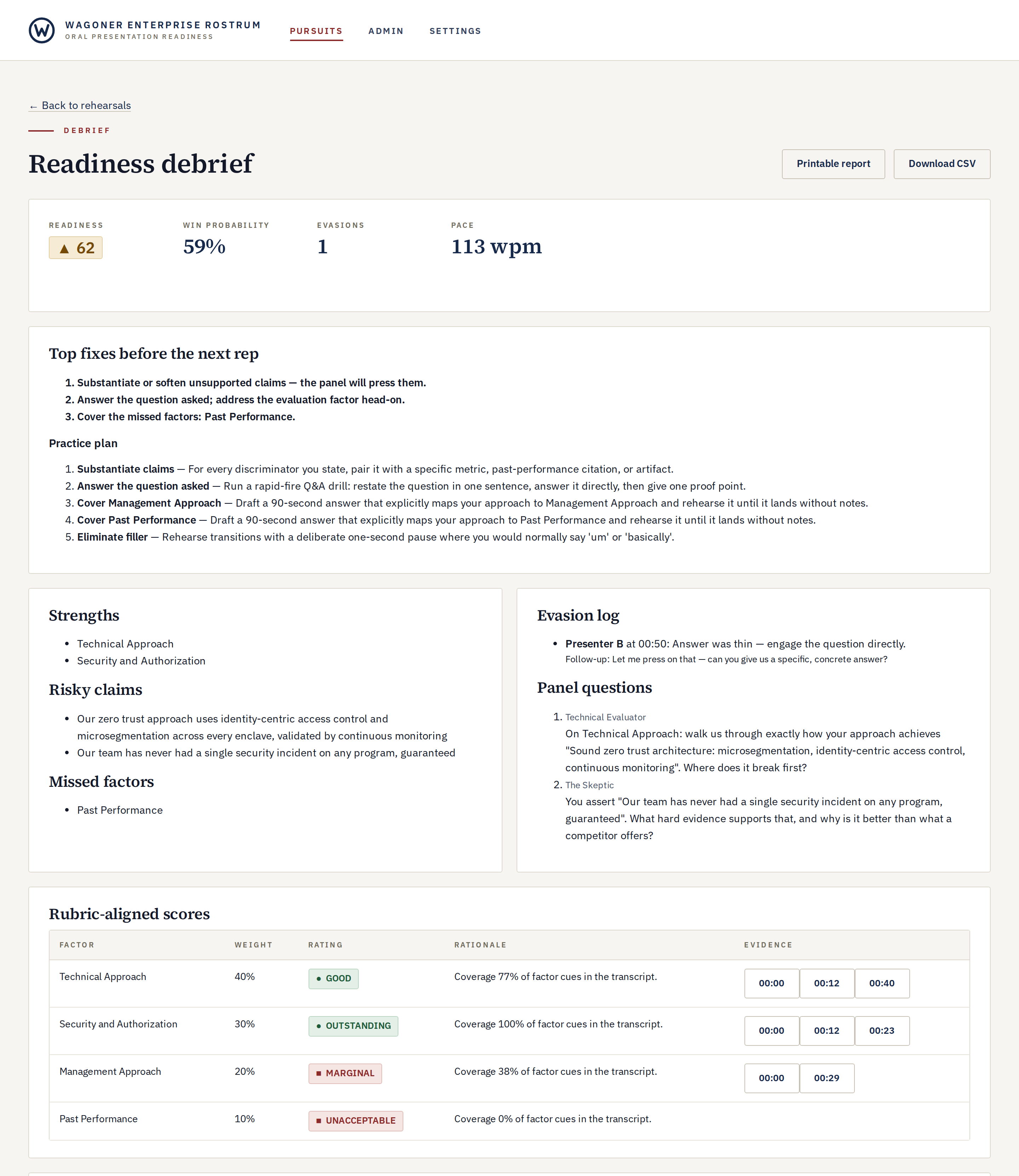
The debrief opens with the top fixes, then factor ratings with evidence and a practice plan. Trends show whether the next rep closed the gaps.
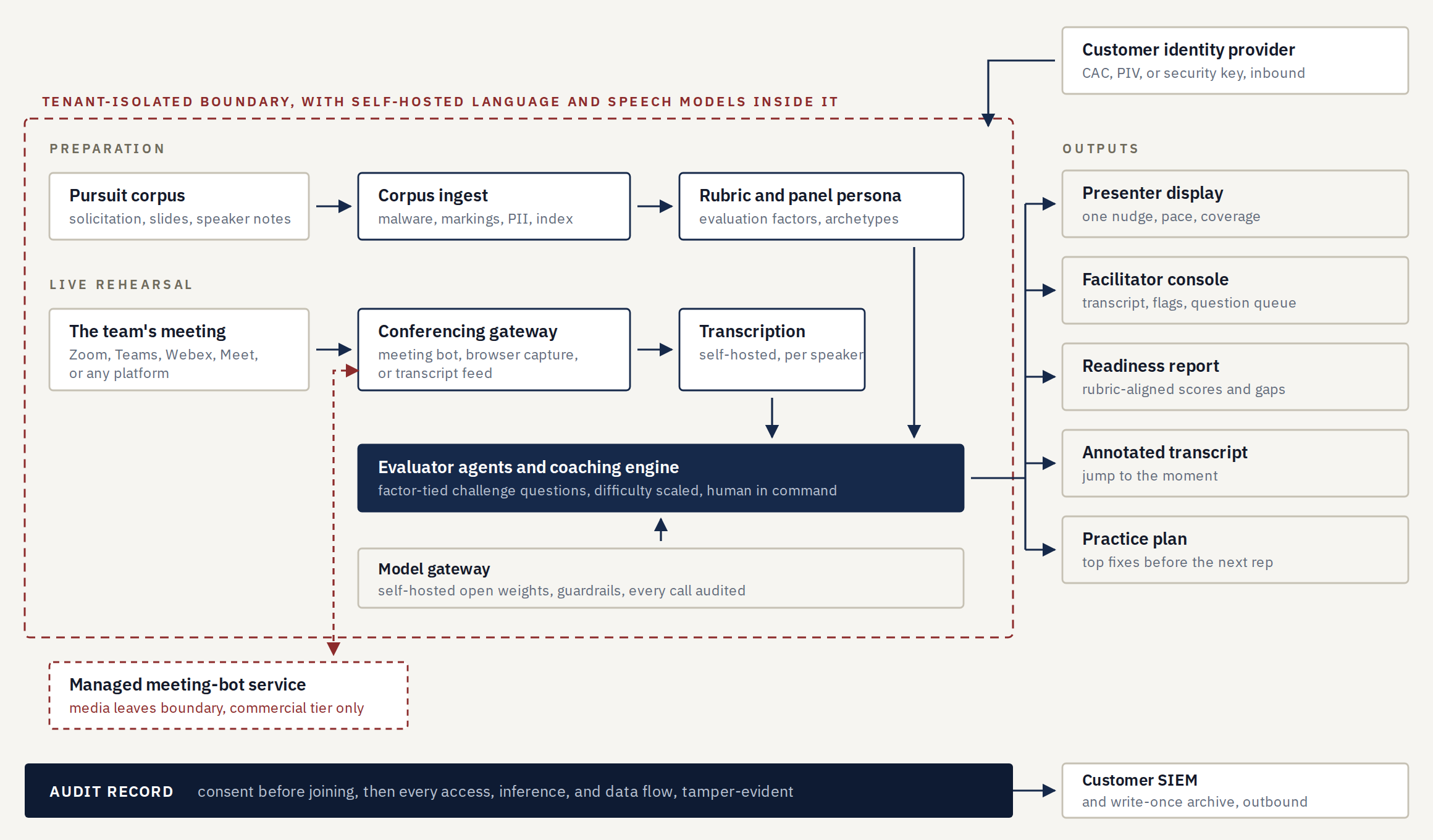
Two lanes converge on the panel.
Preparation grounds the panel in the engagement, and the live lane carries the rehearsal. Every step is recorded.
What the facilitator and the team see.
The facilitator console steers a rep. The readiness debrief is what the team takes into the next one.
Built to sound like the people scoring you.
Delivery coaching tools measure pace and filler words. Rostrum asks whether an answer would have satisfied the evaluators.
It adopts the panel's stance
Five evaluator archetypes question in their own styles: technical, program management, contracting, mission security, and a skeptic. Each persona trait cites the agency material it came from.
Grounded in this solicitation
Answers are scored against the factors, subfactors, and weights in Section M, under the presentation rules in Section L. Questions and scores cite their sources, and output with nothing to cite is suppressed.
Inside the real rehearsal
Rostrum connects through a Microsoft Teams media bot, browser capture from the facilitator, or a transcript feed from any platform. It recognizes each enrolled presenter by voice, and no bot joins without recorded consent.
It catches what loses evaluations
Claims are checked live against the claim ledger, and evasive answers draw a follow-up. Factors the team never touched are flagged before the rep ends.
Models stay inside your boundary
Language, speech, and search models are self-hosted behind one gateway that applies guardrails and records every call. No pursuit material goes to a third-party AI service.
Fenced tenants, tamper-evident audit
Every route is authorized and fails closed, and each tenant's content is encrypted under its own key. Every request lands in a tamper-evident audit log that forwards to your SIEM.
Where Rostrum sits among the alternatives.
Each alternative does part of the job. Rostrum pairs the board's stance with the solicitation's criteria, inside a boundary your security team can approve.
| Capability | Rostrum | Manual murder board | Delivery coaching tools | Sales-roleplay AI | GovCon proposal platforms |
|---|---|---|---|---|---|
| Takes the board's stance | Five evaluator archetypes | Staffed by colleagues | No | Buyer persona | No |
| Grounded in this solicitation | Rubric from Sections M and L | Varies | No | No | Written proposal only |
| Live challenge questions | Factor-tied, adjustable difficulty | Yes | No | Yes | No |
| Over-claim and evasion detection | Against a claim ledger | If someone notices | No | Partial | No |
| Repeatable scoring and trends | Adjectival ratings, rep trends | No | Delivery metrics | Scorecards | No |
| No third-party inference | Self-hosted in your boundary | Not applicable | Typically no | Typically no | Some offer authorized cloud |
Start with one pursuit.
Contractors preparing for orals buy Rostrum. The fastest route to a decision is a small use on material the team already controls.
The lost-bid replay
Point Rostrum at a pursuit whose outcome you know and see whether the panel asks the questions your team was actually asked.
One live pursuit
One orals phase, one capture team, appropriately scoped material, and the security lead involved from day one.
Key-personnel preparation
First-time presenters rehearse until the debrief says they are ready, without tying up senior staff for every practice panel.
Buyers are capture and proposal leaders at prime and mid-tier contractors and proposal consultancies, with the ISSO as a required approver. PursuitIQ writes the proposal, and Rostrum rehearses the orals that follow. The same engine rehearses any panel scored against stated criteria.
The frameworks it is built against.
Each entry describes alignment and work completed, not a certification or an authorization.
- Rostrum is for rehearsal, never for use during an actual government presentation
- The panel advises and challenges. People decide
- Readiness scores and win-probability estimates are coaching aids, not predictions of award
- It does not hold material above the level its deployment is authorized for
Bring a solicitation you have already lost.
The fastest way to judge Rostrum is to point it at a pursuit whose outcome you already know, and see whether the panel asks the questions you were actually asked.