
MISSION PLATFORMS

PursuitIQ

The governed proposal cockpit, from capture to submission inside your own boundary.

Wagoner Enterprise PursuitIQ carries a federal pursuit from opportunity and recompete intelligence through capture, authoring with an AI copilot, readiness, pricing, and award. Every AI request is checked against the content's sensitivity and the customer's approved providers, and AI text reaches the document only when an author applies it.

Shared multi-tenant Dedicated single-tenant Disconnected enclave Kubernetes-deployable
Ideal buyer Capture and proposal organizations And the security officer who approves AI on CUI
Primary output Submission-ready proposal Compliance matrix, volumes, audit record
Deployment Containerized on Kubernetes Shared, dedicated, or disconnected
Standards context SP 800-53 · SP 800-171 · SP 800-207 Alignment in direction, not an assessment
FOR THE EXECUTIVE

Turn on AI for proposals without failing your security review.

Proposal teams want AI now, and security needs to know where solicitation content goes and who approved each word.

The outcome

One record from opportunity to award.

Discovery, bid decisions, teaming, authoring, pricing, submission, and debrief share one tenant-scoped record. Requirements are captured once instead of retyped across a CRM, a file share, a spreadsheet, and email.

The risk it retires

AI that security can approve.

Sensitive content cannot reach an AI provider the customer has not approved, and the default is deny. AI never edits a proposal on its own. Every generation and every applied suggestion is logged.

Why now

CMMC and generative AI are arriving together.

CMMC requirements are being phased into DoD contracts, so contractors handling CUI must show controlled data handling. Proposal teams are adopting AI faster than security teams can approve it, and one governed platform answers both.

HOW IT WORKS

Six stages, one deployment boundary.

Each stage leaves a reviewable record. Authoring, search, review, and export keep working when AI providers or connectors are unavailable.

1

Discover

Opportunities arrive from public procurement sources and the customer's own market-intelligence subscriptions, normalized and de-duplicated. Contracts nearing recompete are tracked from public award history.

2

Qualify and capture

Gate reviews record go, no-go, or conditional decisions. Win probability is broken into factors with a rationale for each, and any override records a reason.

3

Structure

A guided wizard builds the proposal from a linked opportunity and the uploaded solicitation. A background workflow extracts requirements, proposes volumes and sections, and seeds the compliance matrix.

4

Author

Writers work in a rich-text editor with comments, autosave, and version history, with an AI copilot beside it. Copilot output enters the document only when the author applies it.

5

Review and ready

Color teams use typed comments: strength, weakness, deficiency, suggestion. A readiness check lists what still blocks submission.

6

Release and learn

Volumes export to DOCX or PDF with a table of contents and the compliance matrix. Awards and debriefs are recorded, and debrief lessons feed the content library.

REFERENCE ARCHITECTURE

Six layers inside a boundary the customer controls.

The browser holds no tokens or secrets, and every call passes a gateway that resolves the tenant and checks access. Every route out of the boundary is named.
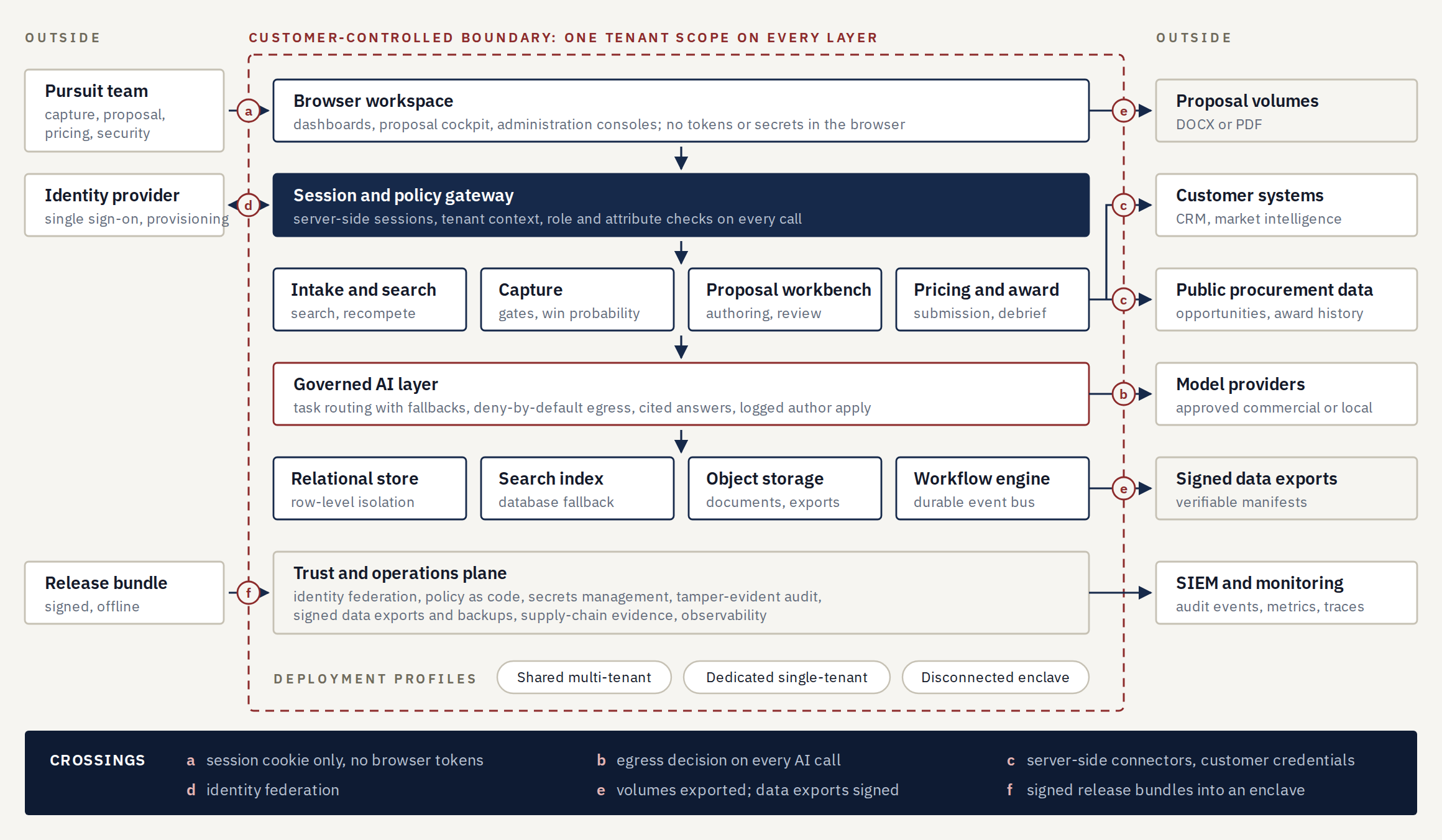
PursuitIQ reference architecture Six layers sit inside a customer-controlled boundary that applies one tenant scope to every layer. A browser workspace with dashboards, the proposal cockpit, and administration consoles holds no access tokens or secrets; the pursuit team reaches it with a session cookie only. A session and policy gateway keeps sessions on the server, resolves tenant context, and checks role and attribute access on every call, with sign-in federated to the customer's identity provider. Domain services cover intake and search, capture, the proposal workbench, and pricing and award. A governed AI layer routes tasks with fallbacks, makes a deny-by-default egress decision on every call to an approved commercial or local model, cites its sources, and logs each suggestion the author applies. A data and workflow layer holds a relational store with row-level tenant isolation, a search index with a database fallback, object storage, and a durable workflow engine and event bus. A trust and operations plane provides identity federation, policy as code, secrets management, a tamper-evident audit record, signed data exports and backups, supply-chain evidence, and observability, forwarding to the customer's SIEM. Server-side connectors reach public procurement data and customer systems such as CRM and market intelligence with customer-held credentials. Proposal volumes leave as DOCX or PDF, tenant data exports leave with signed manifests, and signed release bundles enter a disconnected enclave. The same platform deploys as shared multi-tenant, dedicated single-tenant, or disconnected enclave. CUSTOMER-CONTROLLED BOUNDARY: ONE TENANT SCOPE ON EVERY LAYER OUTSIDE OUTSIDE Browser workspace dashboards, proposal cockpit, administration consoles; no tokens or secrets in the browser Session and policy gateway server-side sessions, tenant context, role and attribute checks on every call Intake and search search, recompete Capture gates, win probability Proposal workbench authoring, review Pricing and award submission, debrief Governed AI layer task routing with fallbacks, deny-by-default egress, cited answers, logged author apply Relational store row-level isolation Search index database fallback Object storage documents, exports Workflow engine durable event bus Trust and operations plane identity federation, policy as code, secrets management, tamper-evident audit, signed data exports and backups, supply-chain evidence, observability DEPLOYMENT PROFILES Shared multi-tenant Dedicated single-tenant Disconnected enclave Pursuit team capture, proposal, pricing, security Identity provider single sign-on, provisioning Release bundle signed, offline Proposal volumes DOCX or PDF Customer systems CRM, market intelligence Public procurement data opportunities, award history Model providers approved commercial or local Signed data exports verifiable manifests SIEM and monitoring audit events, metrics, traces a d f e c c b e CROSSINGS a session cookie only, no browser tokens b egress decision on every AI call c server-side connectors, customer credentials d identity federation e volumes exported; data exports signed f signed release bundles into an enclave
Figure 1. Reference architecture, public-safe. Conceptual view; internal service design, routing rules, and scoring logic are not shown.

Open the full-resolution diagram

THE PRODUCT

Where the writing happens.

The section cockpit puts the editor, the copilot, the instructions, and the compliance requirements on one screen.
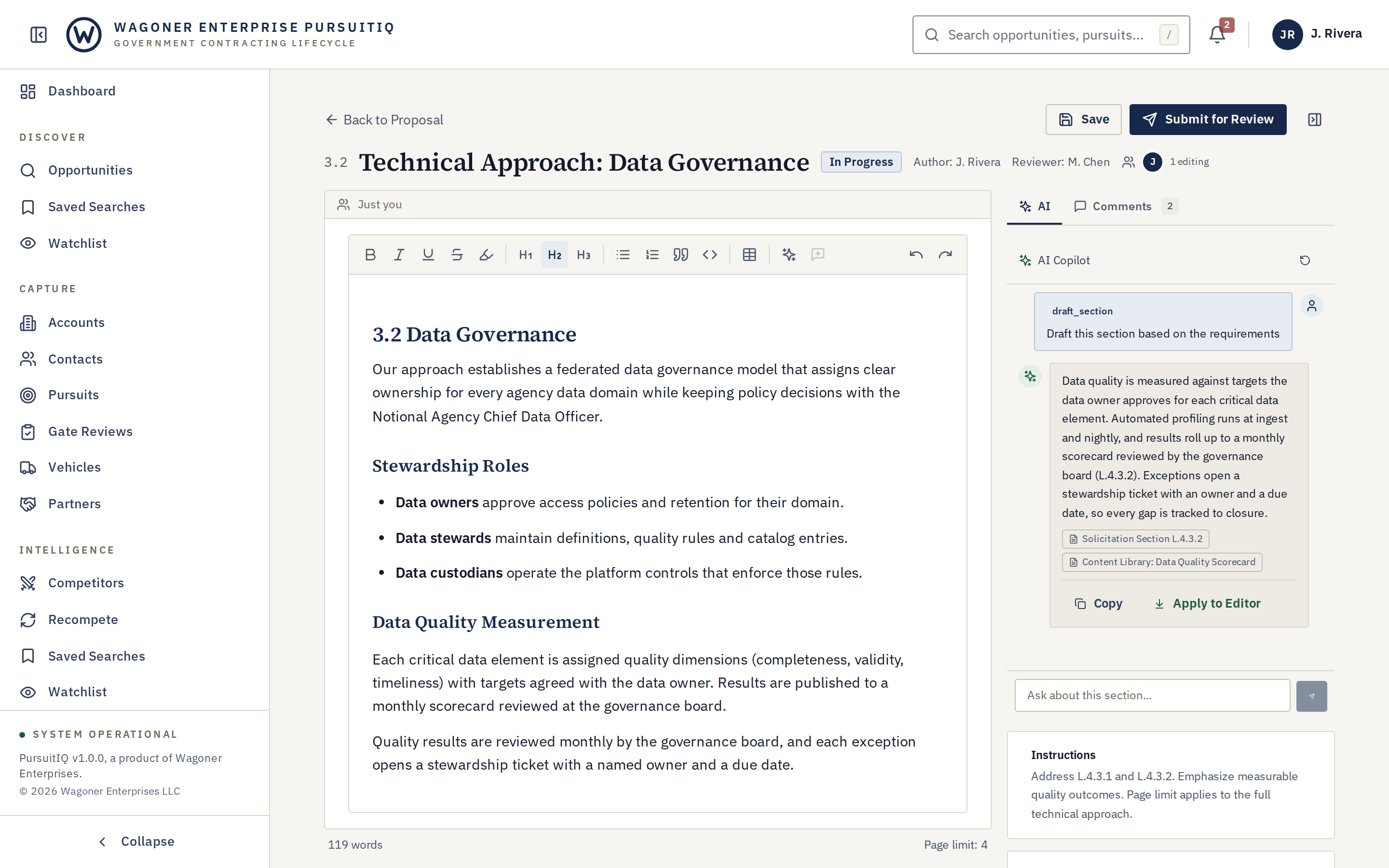
Wagoner Enterprise PursuitIQ · Section Authoring Cockpit
Wagoner Enterprise PursuitIQ section authoring cockpit on a light paper background, with the circle W lockup in the header and a white sidebar listing Dashboard, Discover, Capture, and Intelligence areas. The main pane shows section 3.2, Technical Approach: Data Governance, in a serif title, marked In Progress with author and reviewer assignments. A rich-text editor holds the draft with serif headings, stewardship roles as a bulleted list, and a data quality table. A right-hand AI panel shows a Draft request and a response citing the solicitation and a content library entry, with Copy and Apply to Editor buttons, followed by the section instructions and compliance requirements.
Figure 2. Section Authoring Cockpit. The copilot's cited response waits until the author selects Apply to Editor. Sanitized screen with representative, synthetic data.
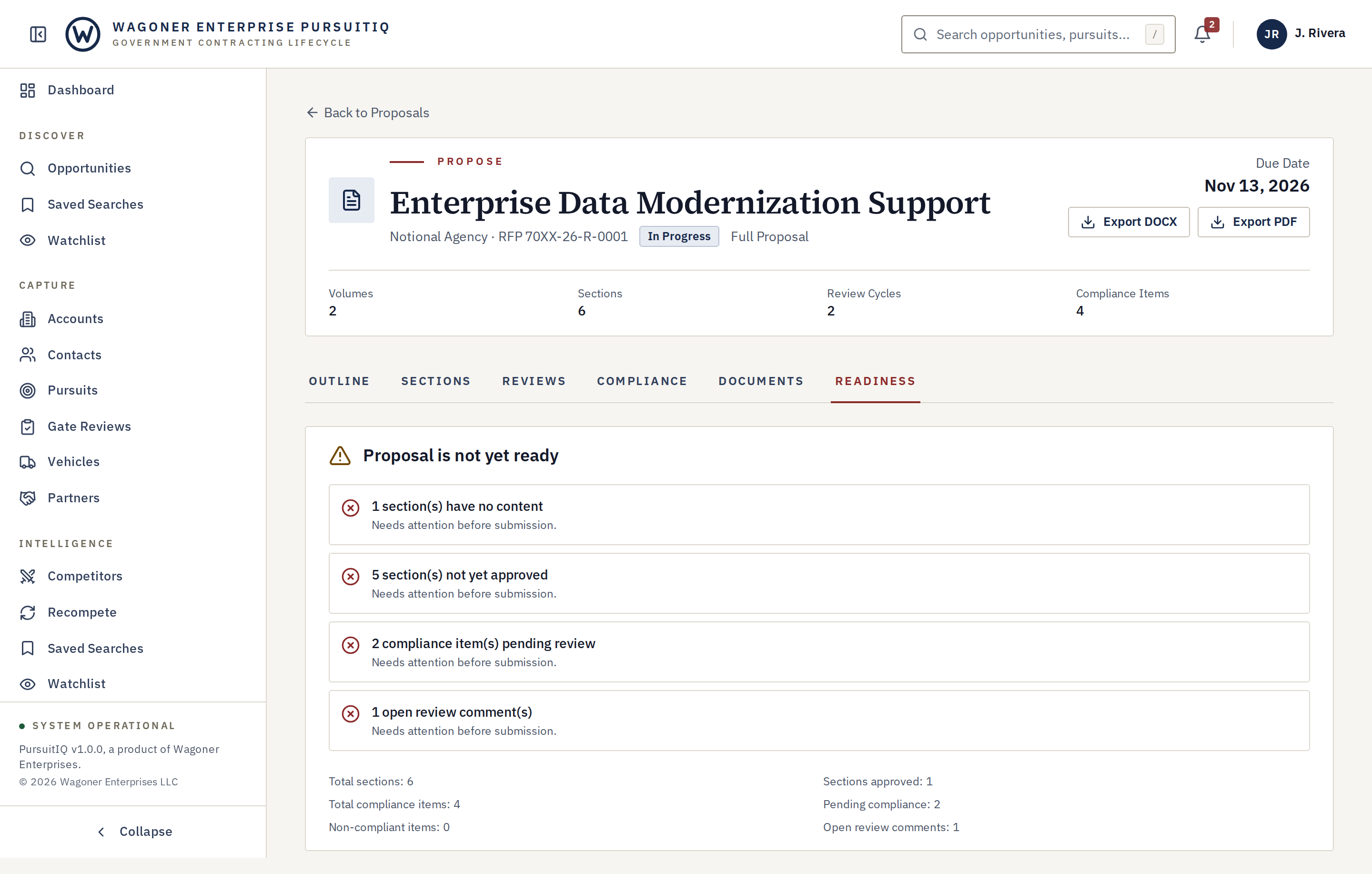
Wagoner Enterprise PursuitIQ · Proposal Readiness
Wagoner Enterprise PursuitIQ proposal workspace under a Propose eyebrow, titled Enterprise Data Modernization Support for Notional Agency in a serif heading, with a due date and Export DOCX and Export PDF buttons. Summary counts show 2 volumes, 6 sections, 2 review cycles, and 4 compliance items. The Readiness tab, underlined in oxblood, shows the proposal is not ready and lists four blockers: 1 section with no content, 5 sections awaiting approval, 2 compliance items pending review, and 1 open review comment, with totals below.
Figure 3. Proposal Readiness. The readiness check names each blocker so the team can clear them before color team. Sanitized screen with representative, synthetic data.
WHAT SETS IT APART

What a security officer can approve.

AI governance in the platform

Each AI request is checked against content sensitivity and a tenant allowlist of providers, so CUI cannot reach an unapproved external model. Output goes back to the author, and each generation and apply is logged.

Your model, or none

Administrators route each task to an ordered chain of commercial or self-hosted providers with fallbacks. With AI switched off, authoring works fully and the copilot says it is unconfigured instead of showing canned text.

Capture you can explain

Win probability shows its factors and the reasoning behind each, and overrides keep a reason and a history. Teaming partners, vehicles, and competitor notes sit beside the pursuit.

Readiness before the deadline

The readiness check names empty or unapproved sections, pending requirements, open comments, and page-limit overruns. Volumes export with a table of contents and the compliance matrix.

Isolation and evidence built in

Sessions stay on the server, and tenant isolation holds in the application, the database, and the search index. Audit records are tamper-evident, and data exports and backups are signed and verifiable.

Deployed where you need it

The same images run shared, dedicated, or disconnected, and enclave releases ship as signed offline bundles. Editing continues when AI, connectors, or search are down.

HOW IT COMPARES

Built for the whole pursuit, under governance.

Each category does part of the job well. PursuitIQ combines the full lifecycle, governed AI, and deployment inside the customer's boundary.

Category-level comparison based on typical capabilities in each category; individual products vary.
Capability PursuitIQ Market-intel subscriptions Proposal content and RFP tools Cloud AI proposal writers CRM plus file share
Opportunity discovery and recompeteBuilt in; ingests your subscriptionsStrongNot a focusLimitedNot a focus
Capture gates and win probabilityNative, explainable factorsPartialNot a focusLimitedGeneric pipeline
Proposal authoring and reviewRich text, versions, typed reviewNot a focusVariesVariesFile-based
Sensitivity-aware AI, choice of modelDeny by default; any approved provider or noneNot a focusRareUsually one cloud vendorNot a focus
Dedicated or air-gapped deploymentSupportedNoRareRareVaries
Tamper-evident audit, signed exportsNativeNot a focusRareRareNot a focus
WHERE IT LANDS FIRST

Start with one proposal team and one live bid.

No connectors are needed to begin; the team works from the uploaded solicitation.

Entry use case

Governed AI drafting

Give the proposal team AI on sensitive solicitations, with an approved-provider list and a logged record of every generation.

Entry use case

Compliance and readiness for one bid

Upload the solicitation, seed the matrix, and clear readiness blockers before color team.

Entry use case

Recompete watch

Build pipeline from public award history and bring capture into the record the proposal team uses.

Bought by capture and proposal leaders at federal integrators and small-business primes, with the security officer who approves AI on CUI.

STANDARDS AND MATURITY

Built against the guidance your reviewers cite.

Product documentation maps features to federal guidance a program can inherit. This is alignment in direction, not an assessment, authorization, or certification.

Primary references
NIST SP 800-53 Rev. 5Access control, audit, identification and authentication, and system integrity narratives
NIST SP 800-171 · CMMC Level 2 contextSupports a contractor's own implementation; the SSP and assessment boundary remain the customer's
NIST SP 800-207Server-side session mediation and per-request policy checks
NIST SP 800-218 (SSDF)SBOMs, image signing, and provenance in the release pipelines
Maturity and intellectual property
Technology readinessTRL 6. System prototype demonstrated in a relevant environment, supporting a live federal pursuit from capture through submission.
Intellectual propertyPatent pending. Wagoner Enterprises, LLC has filed United States patent applications covering technologies in this product. No patent has yet issued.
No ATO, FedRAMP authorization, or CMMC assessment is claimed. Internal design detail is available under appropriate agreements.
GET STARTED

Run it against a solicitation you know.

We walk a representative solicitation through structuring, governed authoring, readiness, and export on sanitized data, then hand you the compliance matrix, volumes, and audit record to inspect.

Request Technical Walkthrough Back to all solutions Sanitized demonstrations available for classified environments.