
Palisade
Zero Trust changes your engineers can ship and your assessors can check.
Wagoner Enterprise Palisade reads the flow, identity, asset, and Kubernetes telemetry you already collect and turns it into a ranked list of Zero Trust changes. Each change arrives as configuration with its rollback, an impact estimate, and signed evidence an assessor can verify offline.
A Zero Trust plan your engineers can carry out.
Agencies already own the products Zero Trust needs. What stalls them is the step between strategy and a safe change window.
Progress measured in changes shipped.
Teams get a ranked backlog of changes drawn from how the network actually behaves. Each one is ready to review, with its rollback and a record of who approved it.
Outages, lockouts, and missing evidence.
A change that breaks a mission system is why many programs stop moving. Palisade shows what each change would break before approval and signs the evidence for the assessor.
Zero Trust is in the implementation phase.
Executive Order 14028 and the guidance that followed moved the question from whether to adopt Zero Trust to how to execute it. Programs now have to show the work without disrupting the mission.
From telemetry to a signed change package.
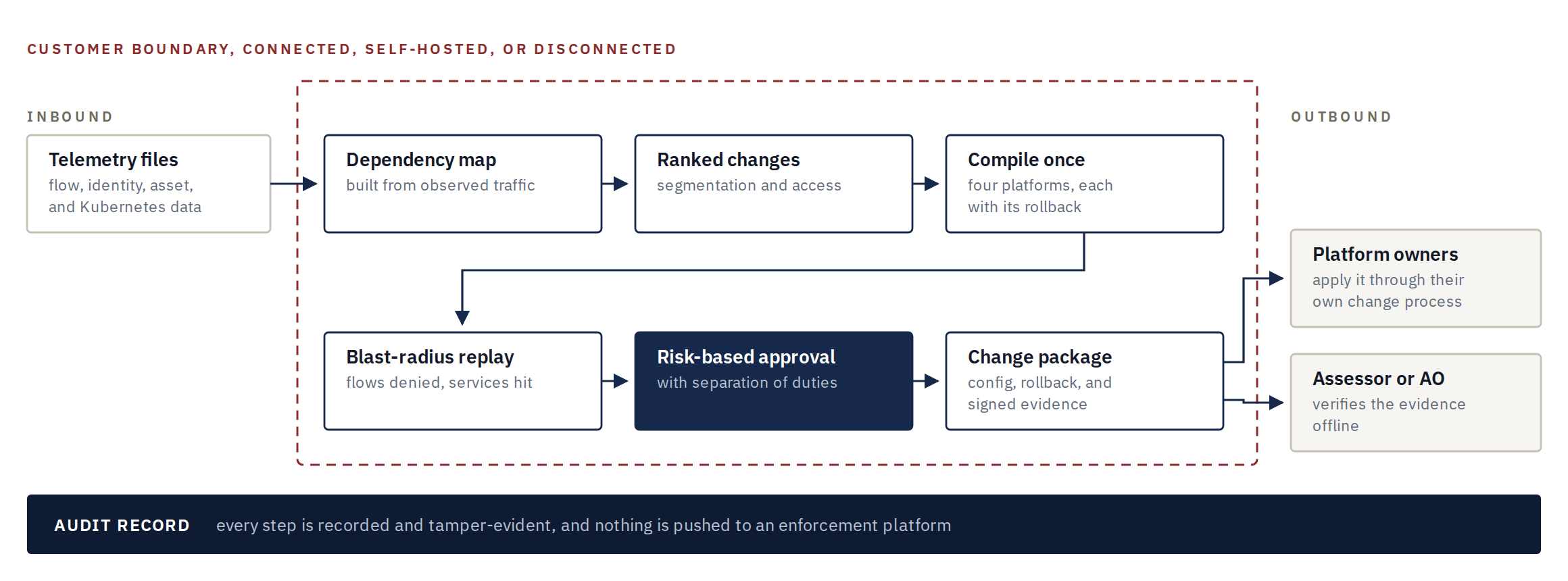
The workflow is the same in connected, self-hosted, and disconnected deployments.
Ingest
Load flow logs, sign-in events, asset inventory, and Kubernetes workload data from files.
Map
A dependency map built from observed traffic flags hosts that could serve as lateral-movement hubs.
Recommend
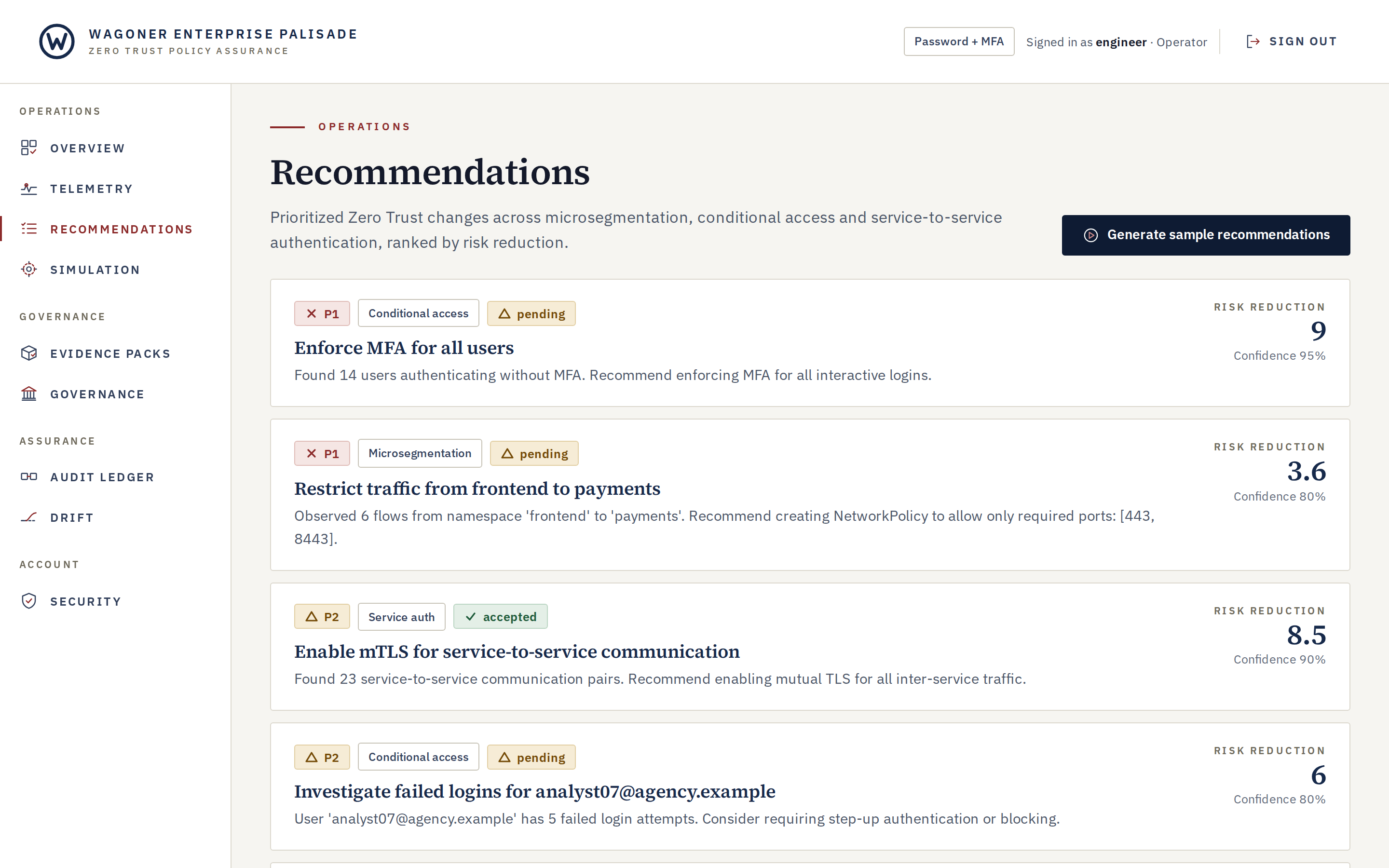
Changes are ranked across segmentation, conditional access, and service authentication, each with its rationale and a confidence value.
Compile
One policy intent becomes configuration for Kubernetes, service mesh, firewall, and conditional-access platforms, each with its rollback.
Simulate
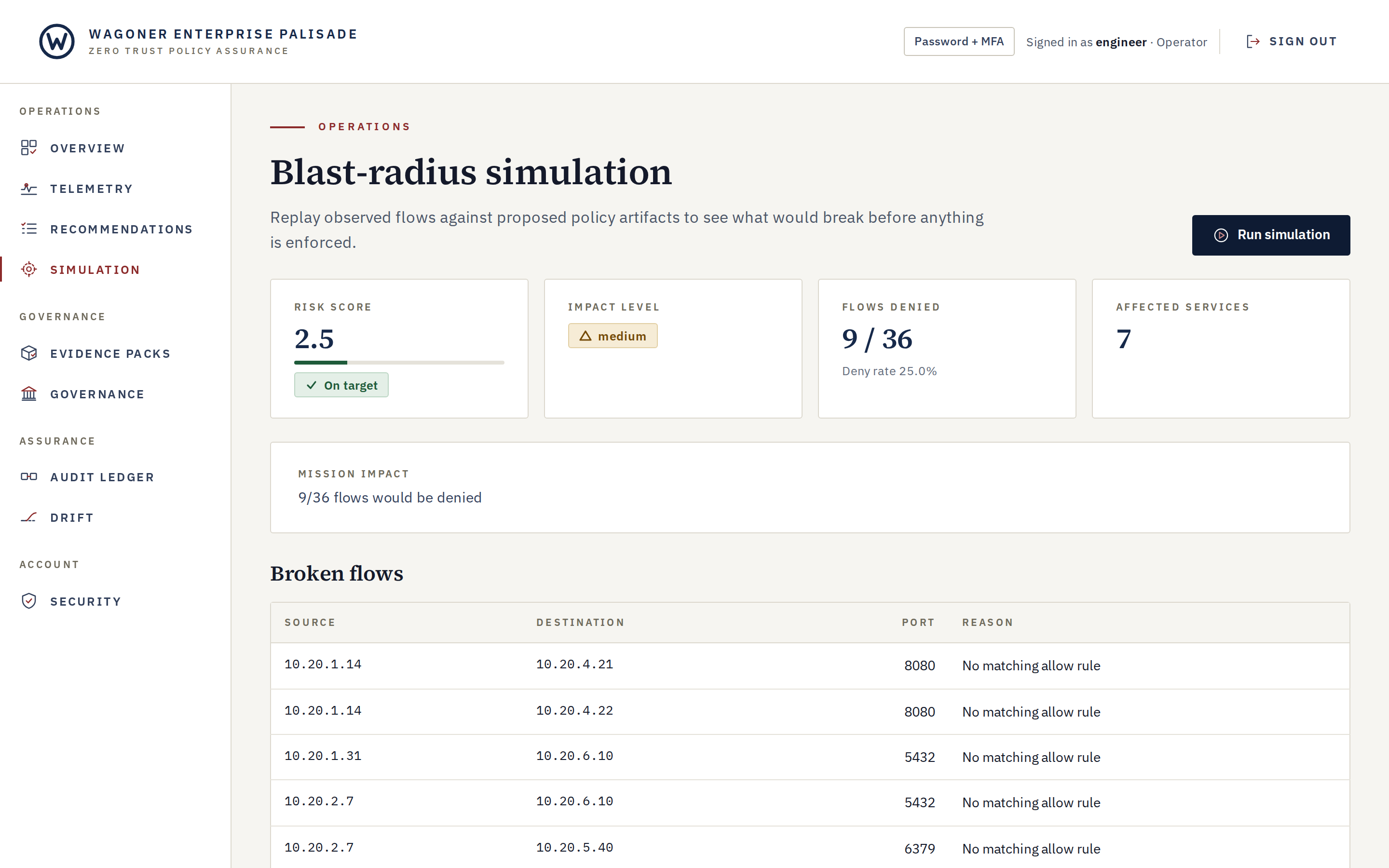
Observed flows are replayed against the proposed policy, so the engineer sees which flows would be denied and which services would feel it.
Approve and package
The approval a change needs follows from its risk, and nobody approves their own change. Approved changes leave as packages with signed evidence.
Telemetry in, reviewed changes and evidence out.
Everything runs inside the customer boundary. Palisade never writes to an enforcement platform; platform owners apply its packages through their own change process.
Know what breaks before you ship.
Two screens from the Palisade console: the impact replay for a proposed policy, and the ranked backlog it came from.
What makes the plan safe to execute.
Works with what you own
One intent compiles to four kinds of enforcement platform, so a change is written once instead of once per team. Palisade plans the change and your existing products enforce it.
Rollback with every change
Each compiled change ships with the artifact that reverses it. The package is a handoff to the platform owner, never a button that alters production.
Impact known before approval
Replay against observed traffic shows the flows a policy would deny before anyone signs off.
Approvals that scale with risk
The risk of a change sets the approval it needs, and a requester can only make it stricter. Separation of duties, step-up sign-in, and a read-only assessor role are part of the workflow.
Evidence that verifies offline
Signed evidence packs and a tamper-evident audit record can be checked with a standalone verifier, with no network and no need to trust the vendor.
Built for disconnected networks
Palisade is self-hosted, ingests from files, and depends on no vendor cloud. Air-gapped and high-side profiles tighten the defaults, including mandatory change approval.
It plans and proves the change. Your platforms enforce it.
Palisade complements most of these categories. It produces the changes enforcement platforms carry out and the evidence governance tools track.
| Capability | Palisade | Microsegmentation platforms | Network security policy management | Kubernetes policy tooling | Zero Trust maturity and GRC tools |
|---|---|---|---|---|---|
| Role | Plans and packages changes | Enforces segmentation | Firewall rule analysis and workflow | Cluster policy and admission | Tracks assessments |
| Basis for recommendations | Observed flow, identity, asset, and workload data | Its own agents or sensors | Rule base and topology | Manifests and cluster state | Questionnaires |
| Impact before change | Replay lists denied flows and services | Monitor or test mode | Path and rule analysis | Audit or dry-run modes | Not applicable |
| Rollback | Generated with every change | Inside the platform | Varies by workflow | Through version control | Not applicable |
| Assessor evidence | Signed packs, verified offline | Platform reports | Change records | Policy reports | Uploaded artifacts |
| Disconnected operation | Air-gapped and high-side profiles | Some on-premises options | On-premises is common | Wherever the cluster runs | Often SaaS only |
Start with one enclave and the telemetry you have.
No connectors are needed. The first engagement runs on uploaded files.
Baseline one enclave
Upload telemetry from one enclave and get back a ranked backlog and a signed evidence pack.
Check a change first
Replay a segmentation or access change and see what it would affect before the change window.
Hand an assessor real evidence
Give the assessor or AO signed packs they verify themselves, instead of screenshots.
Bought by Zero Trust program offices, and used day to day by ICAM leads, network and Kubernetes platform owners, and ISSOs.
Built around published Zero Trust guidance.
Alignment is conceptual, not a certification.
Where the tool stops.
- Palisade supports engineering change control and mission risk acceptance. It does not replace them
- Generated configuration is a starting point that platform owners review and test before deployment
- Replay covers observed traffic, and confidence falls as visibility does
This is a public-safe overview. Recommendation rules, scoring, and internal interfaces are available under appropriate agreements.
See it run against telemetry you recognize.
We run a sanitized walkthrough on representative flow and identity data and hand you the resulting packs to inspect.