
LLM Procurement Compliance Harness
OMB M-26-04 compliance in one workflow: vendor transparency intake, repeatable model evaluation, and a signed Procurement Pack.
Turn an LLM acquisition into a defensible record. The harness standardizes vendor artifact intake and completeness scoring, runs versioned evaluation suites aligned to the Unbiased AI Principles, captures risk flags and reviewer approvals, and exports a single signed Procurement Pack for the contract file. File-based inputs and local execution are the default operating mode, so the same workflow runs on a campus network or inside a disconnected enclave.
LLM procurement arrives as a PDF pile.
Model cards, safety notes, acceptable use policies, and marketing claims vary by vendor and by supply-chain role: developer, reseller, or integrator. Offers cannot be compared on the same basis, and each evaluation team invents its own method.
Policy now expects contractual requirements, vendor transparency, and user reporting mechanisms for LLM acquisitions. Meeting that expectation by hand, per procurement, does not scale, and the resulting record is difficult to defend months later during oversight or a contract modification.
- Vendor disclosures that are inconsistent, incomplete, and not comparable across offers
- Evaluation approaches that differ by team, producing uneven documentation
- Evidence bundles assembled manually for each solicitation, award, and modification
- No durable record of who reviewed what, when, and on what basis
One procurement action, six stages, one signed package.
Work is organized around the procurement action: planned use case, risk tier, stakeholders, vendors, required artifacts, evaluations, and outputs. Every stage produces a durable artifact, and every stage runs identically whether the instance reaches a model endpoint over the network or executes entirely from file-based inputs inside an enclave.
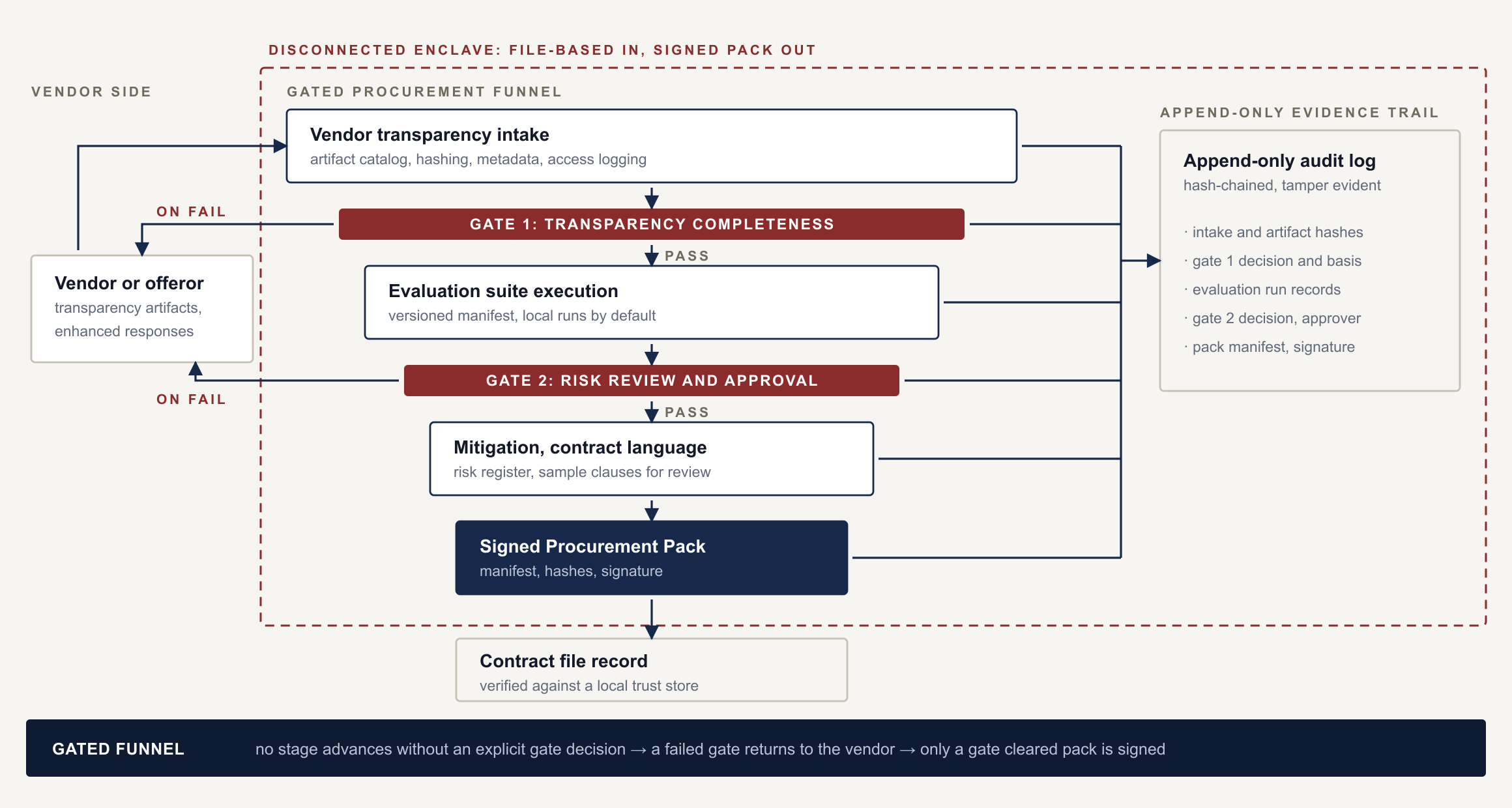
Built for the contract file, not the dashboard.
Scoped to the procurement action
The unit of work is the procurement action and the deliverable is an evidence bundle a contracting officer can file. Governance dashboards describe a model's behavior; this produces the documentation an award or modification has to stand on.
Evaluation suites as versioned manifests
Tests, scoring rules, and pass/fail thresholds are captured as a versioned manifest rather than a one-off spreadsheet. The same suite can be re-run against a later model release or a competing offer and the results compared on identical terms.
Signed, portable evidence packs
The Procurement Pack is a single signed bundle designed to move across organizational and network boundaries and be verified on arrival against a local trust store. Local key-based signing is the default; hardware-backed signing is available where the environment requires it.
Offline-first, self-hosted by default
File-based intake and local evaluation execution are the standard operating mode with external egress disabled. Connected endpoints and optional connectors can be enabled where permitted, without changing the core workflow.
Separation of duties with an append-only record
Analysts collect artifacts and run evaluations; contracting and governance reviewers approve the final pack. Role-based access, tenant-scoped data, and a hash-chained audit log make the approval history reconstructable after the fact.
Requests calibrated to supply-chain role
Expectations differ for a model developer, a reseller, and an integrator. Enhanced transparency requests are triggered by the planned use case and scoped to risk-management information, not to sensitive technical assets such as model weights.
Phased, so the first procurement benefits before the last one does.
Standardize intake
Artifact cataloging, minimum transparency checklist, and completeness tracking, file-based, with no integrations required.
Add repeatable evaluation
Versioned evaluation suites with reviewer workflow, risk flags, exception handling, and documented accepted risk.
Export the record
Signed Procurement Pack generation and contract language stubs, wired into procurement recordkeeping and oversight reporting.
Connect where permitted
Optional connectors and connected evaluation endpoints for automation and continuing governance across a vendor portfolio.
Anchored to the policy your reviewers already cite.
The workflow operationalizes published federal guidance rather than a vendor framework. Control and policy references travel with the Procurement Pack so a reviewer can trace an artifact to the expectation it supports.
Responsible use.
We state the boundaries of the tool plainly, because a contracting officer and a reviewing authority will ask.
- Maturity: Wagoner Enterprises builds GovCon-ready proof-of-concepts and prototypes for federal and defense environments; production hardening, accreditation, and site-specific engineering are scoped per program
- This is decision support and documentation; it does not replace contracting officer judgment, legal review, or program risk assessment
- Contract language output is sample language requiring contracting officer and counsel review; it is not legal advice
- Evaluation results must be interpreted against the planned use case, data sensitivity, and operational controls
- Output quality depends on the completeness and accuracy of the artifacts a vendor actually provides
- High-side operation is a design posture; boundary documentation, hardening, and accreditation remain program responsibilities
See a procurement run end to end.
We will walk a sanitized acquisition through intake, evaluation, and approval on representative inputs, then hand you the resulting Procurement Pack to inspect: manifest, hashes, signature, risk register, and audit log.