
DevSecOps Evidence Builder
STIG-to-code and Software Bill of Materials (SBOM) evidence generation: turning engineering work into assessor-ready proof.
Convert a repository or container artifact into SBOMs, normalized findings, least-diff remediation, Plan of Action and Milestones (POA&M) drafts, and a one-click signed Evidence Pack. File-based ingestion and controlled exports are the default operating mode, so the same workflow runs in government cloud or fully disconnected.
The bottleneck is fixing and proving, not detecting.
Programs already have scanners and dashboards. What they lack is the path from a finding to a safe, reviewable fix, and the packaging that demonstrates what changed, why it changed, and how it supports security expectations.
Evidence becomes a last-minute scramble during assessments and renewals. The work was done; proving it was done consumes the schedule.
- Findings translated into remediation work by hand, inconsistently across teams
- POA&Ms authored late, under deadline pressure, from stale scan output
- Evidence assembled manually for each assessment rather than reused
- No cryptographic binding between the artifact assessed and the artifact shipped
A repeatable workflow from artifact to signed evidence.
Six stages, each producing a durable artifact. Every stage runs identically whether the instance is connected to your SCM and registries or operating from a file-based bundle inside an enclave.
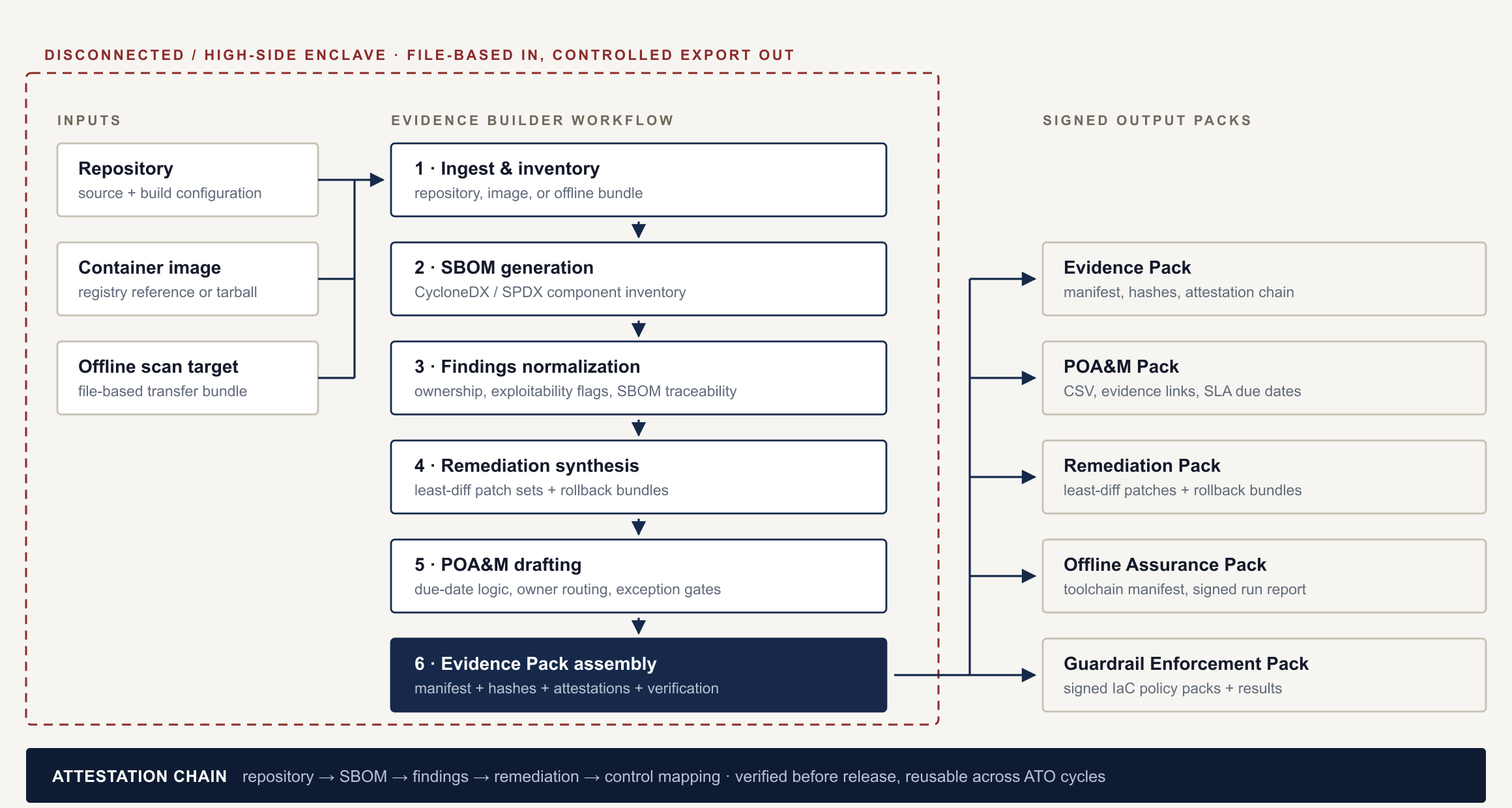
What makes the evidence defensible.
Evidence-native by design
Artifacts are packaged as assessor-ready, cryptographically bound Evidence Packs (signed manifests, content hashes, and an attestation chain) rather than assembled from screenshots and exports at assessment time.
Diff-first remediation
Changes arrive as least-diff patch sets with rollback bundles and validation checklists, so they move through the same review, test, and approval path as any other engineering change.
STIG-to-code
Baseline guidance is represented as versioned, tailorable stubs and scripts rather than prose. Hardening becomes a reviewable artifact under change control.
Offline-first
A portable scanning and policy-gating mode runs fully disconnected from signed toolchain bundles, producing deterministic scan outputs and a signed run report. No mandatory SaaS dependency.
Exploitability-aware prioritization
Findings are ranked into a working backlog using exploitability and known-exploited signals, then converted into auto-drafted POA&Ms with due-date logic and owner routing.
Procurement- and assessor-friendly exports
The Evidence Pack is designed to drop into an authorization package with minimal manual repackaging, and to be verified independently before release or promotion.
Phased, so the first Evidence Pack ships before the full pipeline does.
Establish the baseline
SBOM generation, findings normalization, and signed Evidence Pack export, file-based, with no integrations required.
Add remediation
Least-diff patch sets with rollback bundles and reviewer approval gates wired into existing engineering workflow.
Add prioritization
Exploitability-aware ranking and auto-drafted POA&Ms with due dates, routing, and exception handling.
Extend to the edge
Portable offline scanning and policy gating, plus IaC guardrail policy pack generation and enforcement where permitted.
Mapped to the frameworks your assessor already uses.
The workflow is built around published federal guidance. Control mappings ship with the Evidence Pack so an assessor can trace an artifact to the expectation it satisfies.
Responsible use.
We state the boundaries of the tool plainly, because an Authorizing Official will ask.
- Generated patches and hardening scripts require review, testing, and approval before deployment
- Programs must tailor baselines and remediation SLAs to their own mission risk
- The tool supports Authorizing Official judgment and change management governance; it does not substitute for them
- Evidence quality depends on the fidelity of the scanners and sources feeding it
See it run against an artifact you recognize.
We will run a sanitized walkthrough on representative inputs and hand you the resulting Evidence Pack to inspect: manifest, hashes, attestation chain, and control mapping.