
ClassifyAI
Classify with confidence. Keep the data inside your boundary.
ClassifyAI recommends classification and CUI markings from a document's content and the program's handling policy, then routes every recommendation to a cleared reviewer. Each decision is kept as signed, tamper-evident evidence, and no content leaves the boundary for inference.
Consistent markings you can defend, without moving the data.
Classification becomes a reviewed, recorded process, and sensitive content stays inside the accreditation boundary throughout.
Faster, more consistent marking, with the reasoning attached.
Analysts start from a recommendation instead of a blank page. Each decision carries the rationale, the policy version that applied, and the person who approved it, so an inspector's question has a written answer.
Spills, over-classification, and assessments without evidence.
Marking is usually manual, and programs rarely keep a record of which rule or reviewer produced a marking. A consistent process reduces spills and over-marking, and the signed trail is the evidence an assessor asks for.
CMMC assessments and CUI designation are arriving together.
Third-party CMMC assessments under Phase 2 start in November 2026, and agencies are being pressed to tell contractors explicitly what is CUI. Most commercial classifiers assume content can leave the boundary, which rules them out for these holdings.
The system proposes. A cleared person decides.
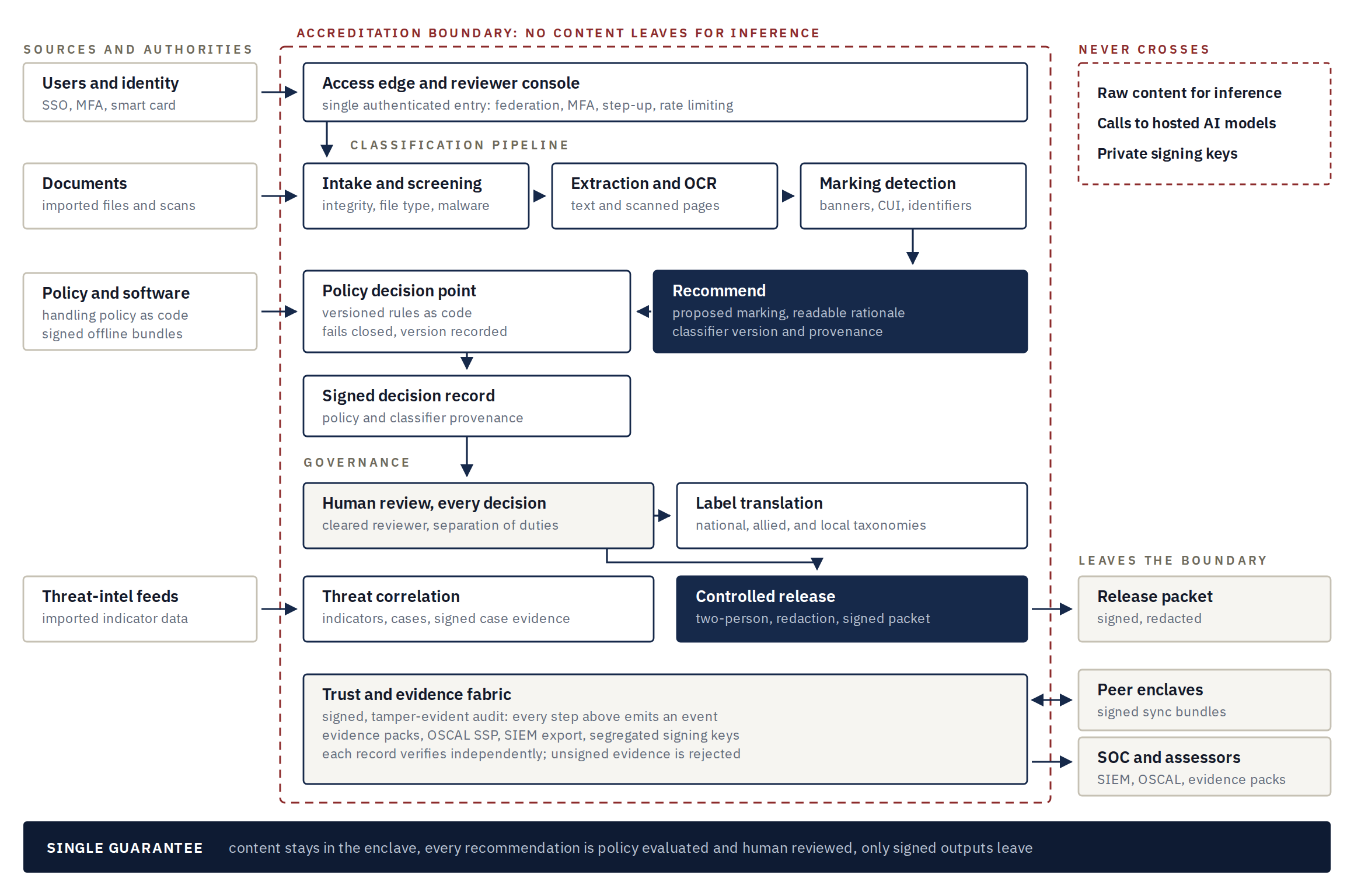
Every document follows the same path inside the deployment boundary, and each stage leaves a record you can inspect.
Ingest and screen
Documents are fingerprinted, checked for file-type spoofing, and scanned for malware with a check that fails closed. Text is extracted, with OCR for scanned pages and images.
Detect
Existing banners, portion marks, dissemination controls, and CUI markings are recognized and validated. Personal identifiers are flagged.
Recommend
A proposed marking comes with a readable rationale and the version of the classifier that produced it.
Evaluate against policy
Versioned policy as code checks the recommendation, and the signed decision records which policy version applied. With no policy loaded, evaluation fails closed.
Adjudicate
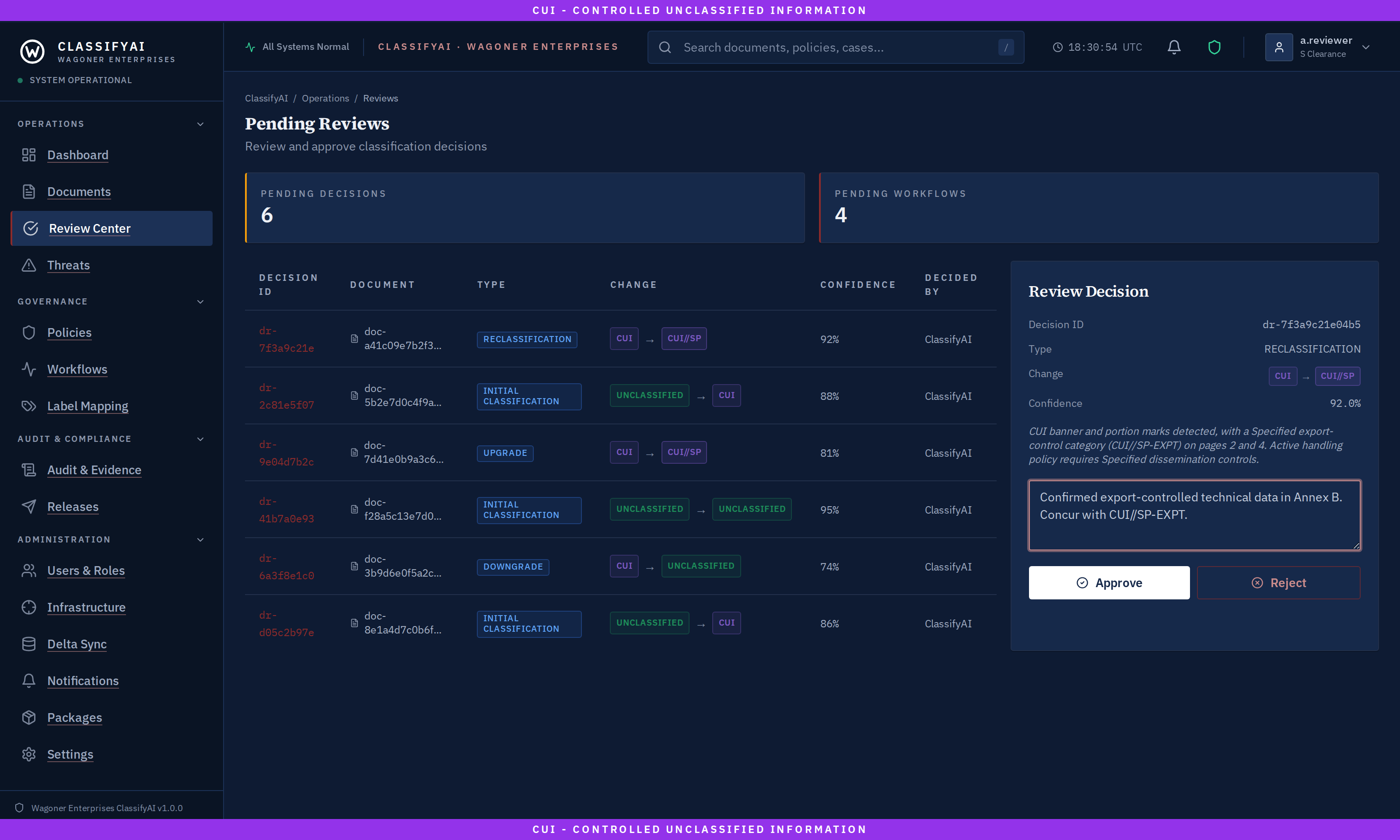
A cleared reviewer approves or rejects with a written rationale. Separation of duties is bound to the signed-in identity, and privileged actions need step-up authentication.
Release and prove
Approved decisions feed two-person controlled release. Every step lands in a signed audit trail that exports as an evidence pack, a SIEM feed, or an OSCAL security plan.
Content stays in. Only signed outputs leave.
Handling policy and software come in as signed inputs, and inference happens inside the boundary with no external calls. What leaves is limited to signed release packets, signed sync bundles, and audit exports.
Every recommendation waits for a person.
A reviewer cannot approve or reject until a written rationale is entered, and that rationale becomes part of the signed record.
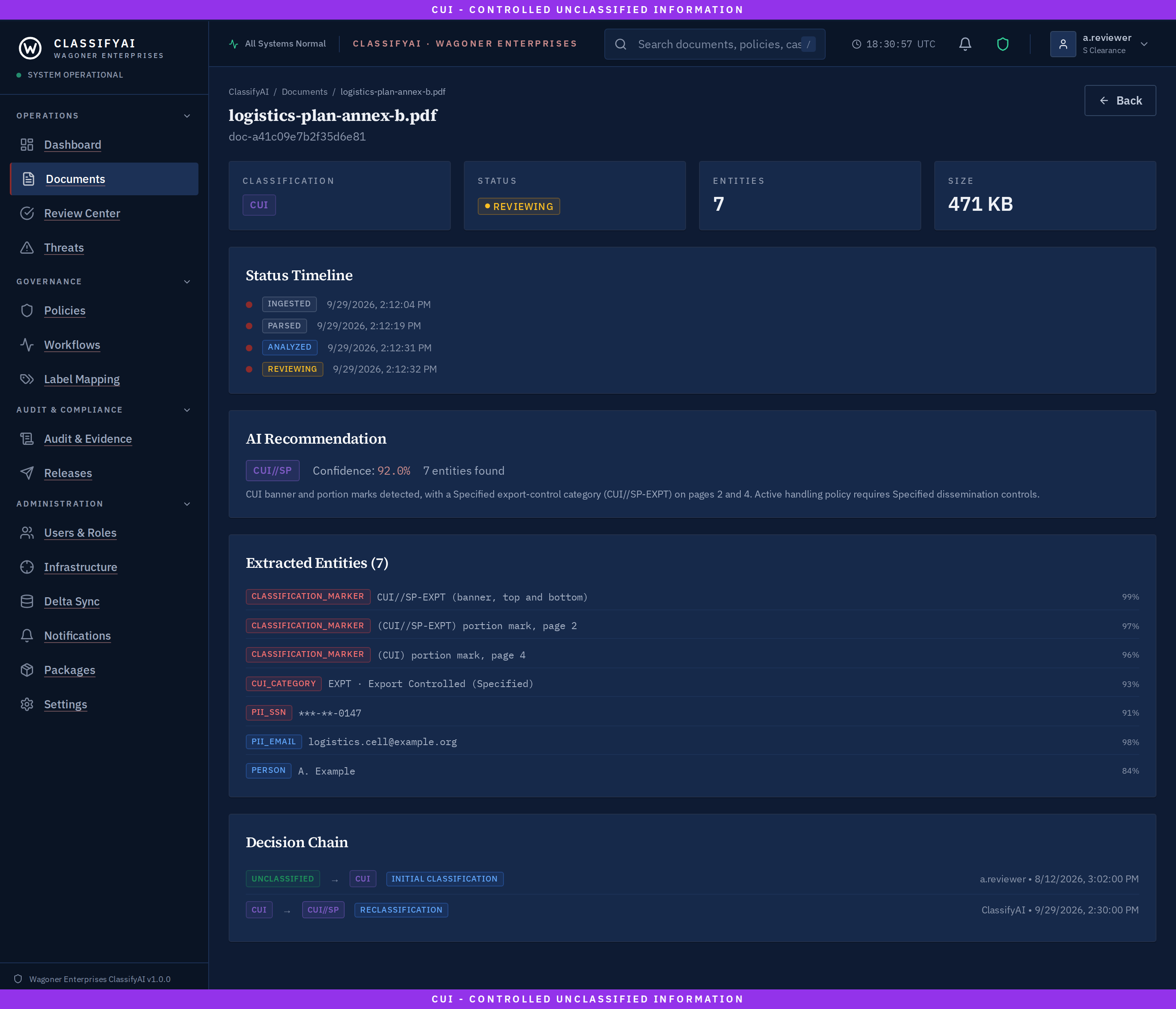
What makes the classification defensible.
No external inference
Extraction, detection, recommendation, and policy evaluation all run inside the deployment boundary. Content never has to cross the accreditation perimeter to be classified.
Policy as code with provenance
Handling rules are versioned and tested as code, and a built-in editor validates and activates new versions. Each decision records the policy version and the classifier that produced it.
Accountable human review
Every decision opens a review, and separation of duties is tied to the signed-in user, with CAC and PIV supported. Clearance is enforced on reads, so an uncleared viewer cannot open a document recommended at a higher level.
Controlled release
Release packets need two-person approval and recipient checks. Their classification comes from the documents themselves, never from the requester.
Signed evidence, ready for assessors
The audit trail, decision records, and evidence packs are signed and verify independently. The same record feeds a SIEM and an OSCAL System Security Plan for ATO and CMMC preparation.
Built for disconnected enclaves
The platform installs from an offline bundle. Separated enclaves stay aligned through signed sync bundles that are checked against a per-peer trust store and quarantined on failure.
A different job from data security or marking add-ins.
ClassifyAI recommends like an assistant, governs like a policy engine, and records like an evidence system. Established categories are ahead on personal-data detection and native label integration.
| Capability | ClassifyAI | Cloud data-security platforms | User-driven marking tools | Cross-domain guards | Declassification AI platforms |
|---|---|---|---|---|---|
| Fully self-hosted or air-gapped | Yes | Mostly SaaS | Yes | Yes | Yes |
| Recognizes classification and CUI markings | Yes | Partial | Own labels | Yes | Yes |
| Policy as code with decision provenance | Yes | Rule or ML settings | No | Rule sets | Varies |
| Human review with separation of duties | Every decision | Limited | User decides | No | Yes |
| Two-person controlled release | Yes, signed packet | No | No | Transfer rules | Varies |
| Signed audit and evidence packs | Yes | Logs | Logs | Logs and attestations | Varies |
Start read-only. Add governance as it proves out.
The first deployment changes nothing about how the program works today.
CUI marking assist for a CMMC enclave
Recognize CUI markings and identifiers, recommend markings, and keep the signed trail an assessor asks for.
Consistency review of existing holdings
Run recommendations read-only against a sanitized corpus. Measure analyst time per document and how often reviewers agree.
Release governance
Two-person release with signed packets for documents crossing organizational boundaries.
Buyers are classification authorities, security managers, ISSMs, and ISSOs in DoD and IC-adjacent programs, and defense industrial base suppliers preparing for CMMC Level 2.
Aligned with the rules your assessor already uses.
Alignment means the design follows the direction each reference sets. It is not an assessment, a certification, or an authorization.
- Output is a recommendation. The classification authority makes the determination
- Every decision goes to a human reviewer
- The platform supplies evidence toward an authorization package; it is not itself an accreditation
- Decision quality depends on extraction fidelity and on the policies the program maintains
See it classify content you recognize.
We run a sanitized walkthrough on representative content and hand you the outputs to inspect: the recommendation and its rationale, the signed decision record, the release packet, and the audit trail.